Thursday, 25 November 2010

Sidekick Books Artist Profile: Monika Cilmi


The first in a series of profiles of selected contributors to Sidekicks books projects. Today I'll be talking to Monika Cilmi, whose calligraphic birds grace many pages in the upcoming anthology Birdbook Part I.

Born in Italy and living in England, Monika Cilmi works as an art tutor and workshop leader in various Colleges in London, and is represented by Tokani Art Agency. She is a visiting lecturer at University of the Arts London and at Middlesex University. She has exhibited her art in Italy, England and Germany and has won prizes for her work. Monika's work features in International Contemporary Artists Volume 1 (ICA Artists, 2010). She is planning projects with galleries in New York, Canada and Germany, as well as a solo exhibition at Colorida Galeria, Lisbon, and publication in an upcoming art dictionary.


A brief interview:

Sidekick Books:
Who or what would you say influences your work?

Monika Cilmi: Japanese art and philosophy, particularly zen brushwork and calligraphy. I am also influenced by the importance of the relationship between body, mind and nature, following my latest research.

SKB: Does the subject matter you use vary wildly, or do you find yourself returning to certain motifs and ideas?

MC: The subject matter is always the same but it is always interpreted and expressed differently through my research on gesture and the use of various materials and tools.

SKB: What convinced you to take part in the Sidekick Books projects?

MC: A passion for nature and birds in particular, but also the opportunity to use my unique style to create the illustrations.

SKB: Do you prefer to work alone or collaborate, and why? If the latter, what would your dream collaboration involve?

MC: I often prefer to work alone but I also enjoy collaborating with other artists. My dream collaboration would be with a composer, musician or dancer for a project that can combine sounds, movements and visual interpretation.

***

See more of Monika's work at www.monikacilmi.com

Tuesday, 23 November 2010

Robots in Scotland!


What have we been up to?

Well now, after a whirlwind weekend of writing and compiling, me and Jon have crafted a pamphlet of collaborative and experimental robot-themed poetry. Forest Publications are releasing it through their chapbook series as "No, Robot, No!", under the pseudonyms Roy Marvin and Eve Bishop (10 points for naming those refs!).

We travelled to Edinburgh to engage in further Forest fun last Wednesday. The night, Golden Hour vs Plastic Forks, involved music, art and a nook of poetic goodness in which we cavorted and frolicked on the themes of technology, the future, dreams and computer games, joined by the likes of Happenstance's Helena Nelson, Rob Mackenzie, Ryan Van Winkle and Dave Coates. Great stuff. More robots.

Thanks also to the lovely Megan and Ben for putting us up and treating us real lovely, with croissants and mammoth pizzas and top charity shopping. We love you guys.

Sour side to our Scottish trip came with a heartburn-expensive plane ticket mix-up and a lost bag. Bag was returned tonight, though. Thank you Claire from BA!

In Sidekick Books news, we just got the proof back for our second book this year, Korsakoff's Paper Chain. We're going to do a twin launch with the awesome Pocket Spellbook when we hold the copies in our grubby paws. No robots confirmed as yet. Equally, robots not ruled out altogether. More to follow on that!

@SidekickBooks

Sunday, 7 November 2010

Stay away from that Trapdoor! (but go to Camden!)


Camden School of Enlightenment
is once more waving its learned and friendly hand! On Tuesday 9th November, pop down to The Camden Head (nee Liberties) for:

Dominatrix of demotic erotica Sophie Cameron. She intends to dispense some much-needed Sex Education for Northerners, the mucky pup.

Jon Stone returns for the second instalment of his microlecture series deconstructing cartoons of the 80s. This time he's taking us spelunking through The Trap Door!

Dali-esque darling Alan Wolfson! For the final show of his all-too-fleeting residency, he's going to relive his Life in Plastic (it's fantastic, apparently).

Our Dead Poet will be Ivor Cutler after a quick rinse and wring through the mind-mangle of Will Hames.

Concealed rather obviously within one of those acts, we'll have the ukulele magic of Caroline "Fourstrum" Grannell, and maybe more pluck-me madness from our friends at UkeyLove

Floor spots are available - sign up at 8 if you can enlighten us on the theme of your choice. See you there! And did we mention it's free, all free?

Facebook event page here!

Also follow host Mike West, alias @camdenlight, on Twitter. Recent gems include:
Corporates: please stop calling people "champions", unless they've actually won at the Olympics or killed a knight in single combat.

and
"Have you swiped your nectar card?" It knows full well I haven't, the sarky get.


For less rapier-witted, but nonetheless enlightening updates, we too have joined the Twitticism Brigade - jump aboard at @SidekickBooks!

Monday, 1 November 2010

Save the Forest!


For the uninitiated (and you're missing a treat), The Forest is the umbrella name for a collective of incredible individuals based in Edinburgh. Hosting a plethora of fun and unusual arts events for free and serving delicious vegetarian food in the Forest Cafe, which is run by volunteers, these guys work their socks off to provide a welcoming ecosystem of arts and culture, promoting the interesting and offbeat and keeping creativity alive in these snip-snip-riddled times.

Here are just some of the things going on at the Cafe: art exhibitions, music nights, poetry, workshops, haircuts and booze (together!), a record label and independent prose and poetry press with lovely handmade pamphlets and games galore!

We have personal reasons for loving the Forest. They gave Fuselit a grant to buy our first laser printer, leading to the more interesting look the magazine sports these days, as well as giving us a grand launch for our Nude issue a few years back, and we're heading back this month on (I think) the 17th November to do an event (more details to come) with a cavalcade of quickfire poetry alongside regular poetryfest The Golden Hour, helmed by Forest stalwart and Crashaw Prize-winner Ryan Van Winkle, who'll be launching his debut collection from Salt. And that's just one of the huge list of shenanigans coming up at Bristo Place.

It's a scary thought that all this fine work might have to come to an end. Here's the situation in their own words:

The Forest has provided a free arts and events space for over a decade and we’ve never asked you to pay to play or to pay to view. We are the only truly autonomous arts and cultural space in Edinburgh and have hosted thousands of free events, exhibitions and straight-up parties. If you don’t know what we do, or have done, you can look at this website. Now, we are in the unique position to either buy our building or fold. All we need to do is raise £500,000. If all our friends and friends of friends donate only £10 — you will have a space in Edinburgh’s historic centre forever. Well, forever is a long time, but for a long time. As long as people are interested in open source community arts spaces. You’ve been directed here by one of your friends because they love this space for good reason. It has nurtured many a soul. Please help us exist for as long as we can by donating just £10 if you’ve been to a free event here. Less if you just like the idea and more if you really really love us.

x Forest


In a nutshell, there it is. It's not a great deal of money if everybody chips in, but it will mean that one of Edinburgh's most community-spirited entrepreneurial arts venues stays open to foster the excitement and pleasure that such a marvellous city and its guests can bring.

You can donate here safely and securely via Paypal, or by credit/debit card. Go on - if you do, I promise not to make any poet-tree puns (oops). Well hell, donate anyway for your love of arts!

***

Find out more about The Forest at www.theforest.org.uk and www.theforest.org.uk

Tuesday, 26 October 2010

Taking Part


Alexandra Joensson and I are going to be presenting at Taking Part: Arts, Culture and Civil Society, which takes place at the South Bank Centre on 29th October and Goldsmiths College on 30th October.

The focus of the conference will be on the role of the arts and cultural production in civil society. For instance, should they be deployed to promote cohesion or to help marginalised groups of people? Or does this simply instrumentalise practices which should rely on their own values to measure their worth, rather than the extent they can be put to use.

We'll be presenting our project X_MSG: Speculations in Social Software and Sex Work Activism, an experimental effort to set up a dynamic many to many text message network in partnership with the sex work worker's co-operative x:talk. The system is designed support the political activism and radical pedagogy of the group, whilst also adapting, reflecting and restructuring (according to) elements of their internal politics.

We'll be present on the Saturday, first in the Short Snaps session (i.e. Pecha Kucha without the copyright infringement) and then in the New Media workshop for the afternoon. With luck, they'll be someone from the South Bank Centre's Global Poetry System there as well, who we can have a right good natter with. Should be fun!

Sunday, 17 October 2010

Poetry London 67


There's a short review of Scarecrows in the new issue of Poetry London (buy from here!) in a round-up of recent pamphlets by Christopher Horton. The magazine generally has a strong reviews section - not so much of the tortured puffery that the modern poetry review is famed for. Jack Underwood is particularly harsh, I think, on Matthew Caley's Apparently, calling it 'blokey' and 'emotionally remote' (with qualifiers) but it's certainly refreshing to see reviewers speaking their mind. Here's a little of what Horton says:

"If at times the sheer frequency of the cultish references and deliberate absenting of narrative threatens complete fragmentation, the sheer dexterity of the language still appeals. Stone has a tendency for spell-like pastiche, appropriate to his often dark subject matter."

Liverpool Biennial Audio Guide


For the tiddly amount of £2.50, you can download Mercy's Liverpool Biennial Audio Guide, which takes you on a tour through 20 imaginary installations, located at various points around Liverpool city centre. Each track can be played separately on a computer, or after downloading to your MP3 player, and is read over soothing mood music. Contributing poets include Byron Vincent, Ross Sutherland, Jack Underwood, Michael Egan, Eleanor Rees, Luke Kennard and Lizzie Nunnery. Kirsty and I also contributed, although we seem to go wholly uncredited! Ah, well.

Saturday, 16 October 2010

My Little Duck/Bimbo/Brat


For Jon, it was Transformers. For me, Christmas and birthday joy was brought about by My Little Pony. A bit too sweet and imbued with a sense of saccharine caring-defeats-those-not-exactly-threatening-bad-guys (if you're satisfied with bumbling comedy witches and purple goo that makes you grumpy), but they were brightly coloured, looked a bit like real horses and had fun tattoos on their arses. With the relaunch of MLP, which began a few years ago, something disturbing started happening.

Firstly, I acknowledge that MLP, in retrospect, sucked. But among the myriad girl-targeted franchises from my youth, it was in fairly sucky company. I never owned a Barbie and Care Bears were only on the the peripheries of my cultural knowledge. I was obsessed with MLP. They were cheap, so I was allowed to collect quite a few through gifts and pocket money, they were blank canvases, so the stories you placed your toys into could be as creative as you liked, and my brother managed to shut me up for hours on one occasion by cunningly suggesting I write down every single pony's name that I could remember. It's been hard to admit, but when you look back and compare the franchise to parallel boy-targeted ones, such as Teenage Mutant Ninja Turtles, Thundercats, Bravestarr etc., it was the fluffiest, most docile and unchallenging idea to sell to girls. I romanticised the first full-length movie for years until I rewatched it and realised that, with the best will and rosiest goggles in the world, it's utter drivel.

However drippy, though, there was chunky charm in the toys I played with, which would have been early-80s G1 ponies. This was my first one, Cherries Jubilee:


I want you to take a good look at the body shape and general look of the pony. Solid, in proportion, fairly equine. Little rump symbol to reflect their name. Slightly Disney-big eyes but, I think, displaying a kindly, almost comradely, sisterly or mentor-like expression. This toy says "let's run about Dream Valley and have magical adventures and maybe battle a couple lame foes. Sure, plait my mane if you like. Unlike a real horse I won't kick you in the face. We look out for each other here."

Names were fairly sweet, innocent fayre, but at least interesting, adding a splash of individuality to each pony. Early pony names included Twilight, Moondancer, Apple Jack, Glory, Firefly, Medley, Sunbeam, Butterscotch, and of course, the queen, Majesty.

On to the relaunch that kicked off around about 2003 (thanks to Dream Valley). Started promisingly enough.


Look! Similar bodies! Fun names! Great - now kids today can enjoy the same silly, psychedelic quests I enjoyed. Also, a great alternative to Bratz (an aggressive, Chucky-like tribe of pouty, optically monstrous mini-bitches who aim make-up, fashion, pretentious names and snootiness at pre-teens as a template for life. Gak).

But nay. Some team of marketing types (the bogeymen I blame a great deal of terrible things on) decided in the latter days of the last decade to do THIS to the sweet, sisterly/mentorly ponies.


That's right. They made them into Bratz with hooves.
Not so much "Happy Hooves!" as "Like, OMGee!"

Exhibit Two, a pony in theory from the old skool, known as Gusty. We could only identify her by her rump mark, Sarge.


I mean, seriously. It's not just me, is it? They've been (there's no way to put this without looking a bit creepy, so here goes) both infantilised and sexualised. The legs have been made more cartoonishly shapely, the muzzle shortened and cutesified and the eyes, well, they're HUGE. It's a little bit JonBenet Ramsay.

Wiki has a good description:
"The ponies' bodies were shrunk, their heads became larger, and their eyes took on a more child-like appearance. The hair styles of these ponies were also changed ...The current line of My Little Pony is referred to by collectors as G3.5. They are called 3.5 as they are the same characters as the G3 ponies but are more distorted in appearance having almost human like faces ... Many customizers seem to feel that the G3.5 ponies make excellent custom bases for those wanting to create a custom of the Red Queen from Tim Burton's Alice in Wonderland."

Frankly, I think they look more like overly made-up ducks with four legs than the Red Queen, but I see their point. Apparently many of the changes with the ponies were enacted in order to 'give them more personality'. The whole point of toys that don't have 10 batteries and loads of creativity-killing functions is that the owner works out their personality!

The range of ponies was recently reduced, as with Bratz, to a core group (ruining the illusion of an entire fantasy kingdom of cool magical horses), and were named Pinkie Pie (the pink pony above, nicknamed Smexiepie by G3.5-hating MLP fans), Rainbow Dash, Star Song, Sweetie Belle, Toola Roola, Cheerilee, and Scootaloo. Rainbow Dash and Star Song retain a bit of the mystery of the old names, but can you seriously tell me that any of the others would be out of place at a strip joint?

I'm not the best at structuring arguments, and there's plenty of room to tell me that I'm a) reading way too much into this, b) way behind - gender-biased toys have been available for decades and c) worrying way too much when kids will form their own, personalities, independent of their toys, but I'm creeped out by this general move towards a childlike-yet-adult aesthetic in girl-marketed playthings. It's not just that the proportions of MLP version 3.5 are ludicrous, or that their names are patronising, unambitious and utterly uncreative. It's about planting an idea about the importance of looking pretty and sexy in the minds of kids who should be thinking up daft stories and running around on imaginary quests in an escapist landscape. It just feels like 3.5 is about pacifying girls, making them overly aware of gender roles and the body through exaggeration and grotesque stereotyping.

I may be turning into my mum, but I hate seeing little girls in heels, just as I hate seeing a grown woman say "you do that tough task - you're the man".

Tuesday, 12 October 2010

Woo! Magic for all!


I'd begun to think it was all a dream! But no, we are still publishing books under our Sidekick Books imprint, and to prove it, here is the cover of the third microanthology, Pocket Spellbook, which rather does what it says on the tin. Find out more here.

Thanks to all our contributors for helping us keep the show rolling, and especially to Saroj Patel for the wonderful cover artwork. I believe Kirsty is going to start running mini-features here on the various artists who are taking starring roles in our next few books, so keep a curious eye out.

Sunday, 10 October 2010

Pomegranate 12: Ice!


I have a poem in the latest issue of Pomegranate, alongside new work from James Midgley, Joe Dunthorne, Sam Riviere, Nicholas Lui and others, and a review of Identity Parade by John Clegg. The editorial lightly takes me to task for not paying attention to the theme of 'ice', so I thought I'd write a belated ice-themed piece in honour of the continuing strength of this singular poetry e-zine:


Murder Weapons, Series 3, Number 7: Icicle

Always plunged, not swung as with the sickle
or ice-axe, and never ever by lackeys
but by oneself, hilt-deep into the silk
centre or through a window in the skull.

It is the best of all weapons to slake
a certain thirst for mingling colours:
Plump Berry and Terrible Alaska.
A favourite of compassionate killers.

Saturday, 9 October 2010

Critical Close-Up: Felix Dennis


I've been (indirectly) challenged to explain exactly what I see is wrong with Luke Wright's poetry and I think I can understand where the commentator is coming from. Last month I appeared to be making broad swipes at Wright under the banner of 'telling it like it is' but without going into any specifics. Not very useful to the average reader in working out whether I had a point or not.

But while I see the force in a request for proper 'critical' reviewing, I'm not going to start with Wright - for one thing, it's silly to keep on at him as if he's some kind of poetry bogie man, and for another, I had to walk out on his performance the other night to catch a train, so it isn't really doesn't feel right to follow that up with a dressing down. Instead, I'm going to give Felix Dennis the once-over, since there is (I hope) a suitable distance between us, and I'd like to start with something easy.

Before I do that, a short word on why I think the 'critical review' is not very popular. Leave aside everything I said in the last post but one about negativity not making you many friends. There are two main problems: firstly, why waste time deconstructing something you don't like? We only have limited resources for critical analysis; surely these should be spent making positive cases for work that is criminally underrated or ignored?

Secondly, how persuasive can one hope to be? Without playing on an audience's predispositions, positivity is less suspicious, more appealing, more influential, than negativity. At worst, an overly critical piece will galvanise supporters of the derided work, actually increasing its popularity.

That said, I think it's important to discuss what we don't value in poetry as much as what we value. I've found that people are usually quite ready to talk about what they dislike at social gatherings or in small groups, but that this doesn't translate to written or recorded words. Perhaps that's because we're aware of how easy it is to expose our opinions as ultimately groundless or highly personalised. Perhaps. In any case, I think it's worth a shot every now and then.

Felix Dennis is the millionaire owner of Dennis Publishing, and his poetry has been critically endorsed by the likes of millionaire Stephen Fry, millionaire Paul McCartney and millionaire Tom Wolfe*. He claims to be one of Britain's best-loved poets, and in an interview with the BBC on National Poetry Day, he had this to say for himself:

"I'm a popular poet in the sense that my books tend to sell in the thousands, and sometimes in the tens of thousands, rather than in hundreds. Technically, I attempt to integrate structured poetical forms into modern day poetry."

His website also allows you to 'browse a timeline of Felix Dennis' life' and construct a playlist out of the several thousand poems he has uploaded. He's the author of 'How to Get Rich', which contains such sage wisdom as:

"I am convinced that fear of failing in the eyes of the world is the single biggest impediment to amassing wealth."

His wikipedia entry is remarkably similar to the biography in all his promotional material, citing his recovery from a mysterious illness as preceding his entry into the world of poetry. The poem I'm going to talk about is called 'A Sonnet for "Whores"'. It begins like this:

A ‘whore’ they call you in their spite. For shame!
Should men not importune you, (fools and boors),
Who then would stand to shoulder half the blame —
And more than half? God bless, say I, all ‘whores’.

Read the full text.

What's good about it?

As with all Dennis' poems, he knows his way around iambic pentameter and pure rhymes, which enables him to tackle the sonnet form with some success. This is evidently what he means when he says "I attempt to integrate structured poetical forms into modern day poetry". Let's give him the benefit of the doubt and assume he means that, like Glyn Maxwell, Tony Harrison and countless other modern poets, he aims to marry traditional forms with modern themes and syntax. This is fair enough, so long as he's not suggesting that there's anything particularly radical about this.

The inverted commas around 'whores' at least prompts the reader to reflect on the way the word is used, its particular application to women and its use as a tool of oppression. 

What's bad about it?

It may be the most patronising poem I've ever read about prostitution, simultaneously romanticising the whole sorry industry and affecting a kinship with the abused women at the centre of it via the final line's 'we shall'. Genuine empathy is conspicuous by its absence; in its place we have mere unctuousness, a faux-rousing clap on the back for our ladies of the night for 'shouldering' first half, then 'more than half', then 'this world's' blame.

The rhyming is incredibly heavy-handed and dull, with not a single pairing anything less than done-to-death. The twice-repeated 'shame' and 'blame' is particularly wearying.

And is this really 'modern' poetry at all? Who still says 'For shame' with anything but a measure of pantomime? 'Fools and boors'? 'God bless'? 'Come, Aphrodite's daughter'?!? This is pure poncing/strutting/clowning about in a blazer. There's no sense whatsoever of a concern with making language new, or engagement with a difficult subject, or even a joy taken in the words used. Instead it amounts to thin pastiche of 19th century Romantics.

The only image or sensory element the poem seeks to plant in the reader's head is the 'tigers at the kill'. I don't think I've ever seen tigers at the kill, so I thought instead of something out of The Jungle Book and tried in vain to relate this back to what Dennis is talking about. Who or what do the tigers represent exactly? Our lives' drudgeon? Reality? 'Murderous strife'? It seems rather melodramatic to suggest that prostitutes - and not wives or lovers - manage to save us from being torn apart by wild beasts. Rather unfortunately, it also appears to hint that sex workers provide some sort of service to society by being easy targets for Jack the Ripper-types.

Finally, the idea that the word 'whore' is used out of spite rings false. I would say it's generally used in a casual and dismissive sort of way. That's why it's such a powerful weapon of sexism - because it's available to those who are merely unmoved and insensitive, rather than actively aggressive.


(* Some of these may be multi-millionaires or even billionaires.)

Thursday, 7 October 2010

Give Hughes and Heaney a rest


It's National Poetry Day, and there are dozens of events happening all over the country. But as ever, celebrations of poetry are somewhat marred by a rigid conservatism that wastes all the biggest opportunities - a failure of nerve and imagination at the highest levels. The New Statesman has published a lost Ted Hughes poem about the night Sylvia Plath died. The kind of interest this sort of coverage looks to arouse is the same that Heat aims for when it prints pictures of gaunt celebrities sans make-up - an almost scavenger-like fascination with the pain of public figures.

Then there's the news that Seamus Heaney has won the Forward Prize. The shortlist this year for best collection could hardly have been more of an exercise in reinforcing the current hierarchy (it also included the editors of Poetry Review and Cape and one of Heaney's former pupils) and so Heaney winning is the logical conclusion of this exercise. Rather than use the prize as a way of celebrating and nourishing the genuine diversity and range of British poetry, all that is going on here is the cementing of a contrived narrative for the benefit of the 'confused' consumer and future historians. What is any art, after all, without giants - however cynically constructed?

Don't bother with the New Statesman. Don't buy Heaney's book. Go to any one of the innumerable small events taking place today and next week and throughout the year and so on. Go to a library and get out a bunch of books by poets you've never heard of before. Discover and celebrate your own heroes.

Tuesday, 5 October 2010

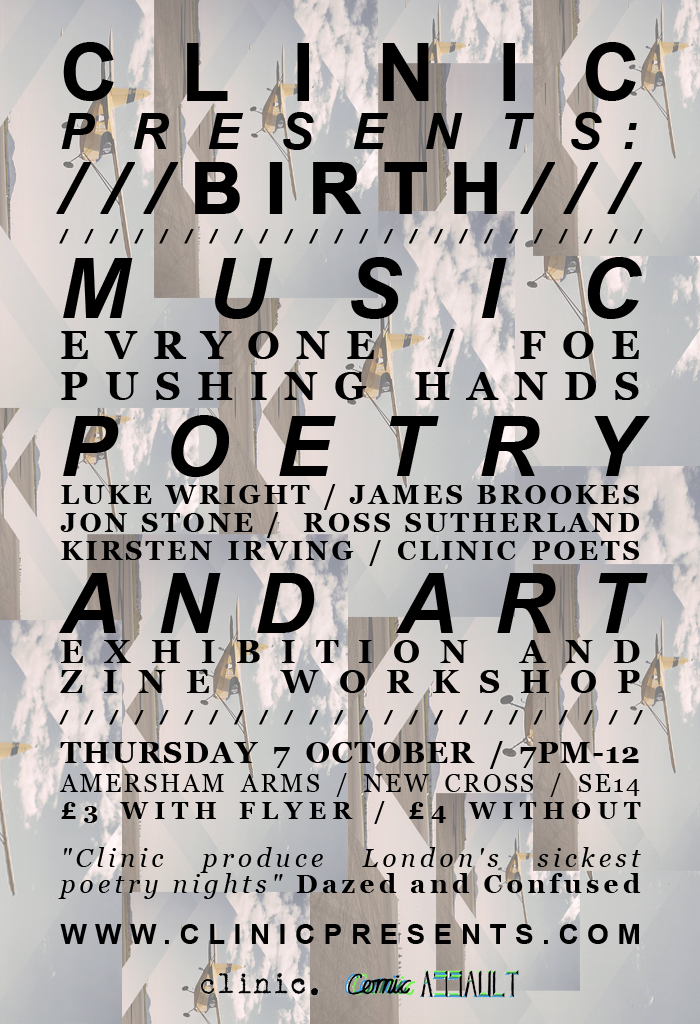
Clinic & Magnifique


Two Fuselit-related events coming this week. On Thursday, Kirsty and I will be reading at the following event:


I'm particularly looking forward to the zine workshop!

Then on Friday, Fuselit will be fielding three readers as part of Broadcast's Magnifique event, alongside fellow London literary journals Brittle Star, Pen Pusher, Rising and South Bank Poetry. Our readers are all recent contributors to Fuselit - Gabrielle Nolan, Declan Ryan and Christos Sakellaridis.

It all kicks off at The Betsey Trotwood, 56 Farringdon Road, at 8.00pm. £5 entry.

Facebook event is here.

Saturday, 2 October 2010

Teaching the regularity of the world


I'm embarking upon a project examining the potential of jokes and other forms of 'paralogics' as engines of social change and upheaval, and as humour and innovation are hardly foreign to the realm of Fuselit, I will be posting some of my speculations and investigations here.

The below is pilfered from a 11+ sample paper on non-verbal reasoning. For the benefit of those outside of the UK, the 11+ is a test some unfortunate children have to take to determine if they are fit to go to the higher stream 'Grammar' schools.

It's an element in paper which asks children to analyse the relationship between the first pair of shapes, and then make a pair with the same relationship.


So here the answer the answer is 'b' – the smaller of the two shapes appears as am even smaller, filled in shape inside the bigger shape. What are we learning through doing such tests? Surely it's how certain relations, certain principles, can be cross-applied from one context to another. One way of viewing this might be to say that it's teaching the principle of analogy, another that of universal law.

Now this one excites the philosophy student in me:


The correct answer, according to the sample paper, is 'e', where the shape is left unchanged bar acquiring a chequered pattern. However, we could also make a case for 'c', where the. Why? Because with the two images on the left, the shape which changes is symmetrical along the horizontal (and vertical) plane, and so we cannot tell if it has been flipped upside-down or not. How can we possibly go for 'e' over 'c' then? Well, it appears that this problem is a visual application of Occam's Razor, the principle which states that given any number of equally likely possibilities, we should always go with the simplest. We do not know that the shape has been flipped upside-down, so we should assume it hasn't.

But what's more interesting is this question contains within the potential for creating a test for paralogical reasoning. By paralogical reasoning, I mean forms likes jokes, sophistry and wordplay. These forms which can bring out amazing possibilities without subscribing to our normal notions of logic and sense. All we have to do for this question is say the answer is 'c' – that we should assume, if nothing is there to the contrary, that objects have been transformed, that we should subscribe to the wildest notions that are available to us.

Perhaps it would be possible to compose an entry paper to a radical and subversive academy, which turns normals notions of sense on their head. But could such a paper ever be marked – wouldn't the most talented students subvert even the modest assumptions such papers must be founded on?

Friday, 1 October 2010

Friday Pickle: To Diss or Not to Diss


Some time ago, the editors of the newly revitalised iota toyed with the idea of inviting submissions of articles which would be published anonymously. The response was an immediate heated debate of what this would entail - much-needed serious critical analysis of poetry from commentators now freed of a fear of black-listing, or lunatic hatchet-jobs and hate tirades from people too cowardly to put their names to their opinions? And is the distance between the two merely a matter of perspective anyway?

One of the biggest stumbling blocks contemporary poetry faces is its lack of an independent critical community. Most who know enough about poetry to form a cogent argument about it (or write about it in any fashion that doesn't expose crushing ignorance) are already practicing poets. Even those who begin with no intention other than to write critically will likely give in to the temptation to give the actual art a go at some point, if only because the distance between writing critically and writing creatively is so small - nothing like the distinction between writing critically about film and going out with a movie crew and several million quid to shoot a movie. The old line about the critic as failed artist fails to ring true with anyone but the most stung creator - critics are, in the main, trusted by the general public, while poets writing about poetry are not (and often with good reason).

Without this independent critical community, the very idea of reviewing negatively (or over-critically) in poetry is taboo. It's unthinkable to the young, aspiring poet because the author of the book they're reviewing could later turn out to be the person who decides whether or not they're accepted onto a course, or published in a journal, or up for an award. It's awkward for longstanding members of the poetry community because if they haven't met the person whose book they're reviewing, they're almost certainly a friend of a friend. And it's a serious risk for anyone because to utter real criticism from any position outside of permanently assured critical and commercial success might well earn you the reputation of a sore loser (not least because there are any number of genuine sore losers out there). Anyone who waded through my recent unsatisfactory attempts to land a shot on the performance poetry scene will have noticed that while the responses were generally mature, I was still accused of sour grapes.

Finally, it's a problem for poetry as a whole because all fracases, however intelligent or good-natured, can be regarded as bald men quarreling over combs. We have enough trouble getting poetry taken seriously on any level - why cavil over which is better or worse when nobody else cares?

Then there's the issue with negative reviewing itself. Nearly all poetry requires a certain degree of open-mindedness, and arguably the more genuinely original and groundbreaking it is, the more it demands the critic leave their expectations at the door. Thus, while Hollywood dross can be comfortably savaged by the serious critic, it's extremely difficult to do the same to a poetry collection without sounding like you're just not engaging with the material properly or fairly.

I'm not just talking about reviews here, mind. This applies to all levels of critical discourse, however informal. Think about how often we take a swipe at a terrible TV programme or articulate what we think about certain politicians. For some people (I'm not sure how many) enthusing endlessly comes easy, but for (surely) most of us, not being able to make a dismissive jibe or poke holes in something makes it difficult to talk about at all with any real gusto. Maybe it's because I'm British or something, but I find I'm at my most florid and unselfconscious when taking the piss. I have a huge number of genuine enthusiasms but somewhere between my heart and my mouth, they mostly dissolve into trite, workmanlike recommendations and thumbs ups.

And to be honest, I get rather tired of the trite, workmanlike recommendations and thumbs ups that seem to be the only way most communication about poetry can take place at all. There is an awful lot of work that needs to be congratulated and deserves wider recognition - that I do wholeheartedly believe. But there's a sense of muted desperation about how frequently we have to lightly applaud it, perhaps because sometimes it's the only indication we can give that something exciting is occurring. Imagine if this week's Milliband furore had been confined to a round of hearty congratulations to Ed and commiserations to Dave - would anyone really give a damn what happened next?

There are two broad philosophies that are often extolled (or rather, quietly recommended) in the world of poetry when it comes to behaviour: that is, kicking against the pricks and leaning a bit of humility. I've found myself leaning, at various times, towards one or the other, but lately I've been finding both equally dissatisfying. The prick-kickers seem destined to get nowhere, forever engaged in personal disputes only they care about, drawing up battle lines that make no sense to anyone else. The humility, meanwhile, is too often false, and on a larger scale only works in favour of those poets who are best at networking, since they end up with hundreds of mates all happy to do their PR for them and no one prepared to voice the opinion that they're not all they're cracked up to be. Where on earth can one sensibly stand?