Award-winning university newspaper The Boar has reviewed Ian McLachlan and Phil Cooper's 'Confronting the Danger of Art' thus:
"Imagine a world in which artistic expression is suppressed and condemned by the government. Not too difficult, is it, considering the cuts we have suffered in recent years. Both wonderfully relevant therefore and also intriguing in its portrayal of the thing is Ian McLachlan's 'Confronting The Danger Of Art', a short poetry pamphlet that talks about how to survive an influx of creative types and their work in the style of a 70s nuclear safety information booklet. It is a marriage of ideas that does not sound quite as effective as it actually is; the poetry within providing a hilarious and searing look at the way people do sometimes treat the arts, and how it is a slippery slope potentially towards more totalitarian views ... perfectly crafted and delightfully witty."
Buy 'Confronting the Danger of Art' here, and make an old alchemist marginally wealthier.
Showing posts with label reviews. Show all posts
Showing posts with label reviews. Show all posts
Monday, 13 February 2012


Tuesday, 4 May 2010


Wednesday, 10 February 2010
Introducing Irregular Features!

The inestimable Dr Fulminare of (he of Sidekick Books fame/infamy) begs to alert all merchants, mountebanks, bards and footpads to his latest experiment, Irregular Features, a sporadically updated, peer-reviled journal of poetry goings-on, in which the following reactions and imbalances may or not occur:
- Things to Make and Do - games and guides to coerce you into such unatural practices as generating 10,000,000,000 pantoums in but clicks, using fridge magnets to constuct your own poetry blurb, folding your own stanza-stimulating origami swift, crafting the images of famed poets from dots and much more.
- Poetry Top Trumps - pit the varied talents of Ted Hughes, Frank O' Hara, Getrude Stein and Giorgos Seferis against each other in a duel to the (probably car-crash or oven-related) death, with further metersmiths to be added.
- Woe's Woe - a directory of suffering, for when 'blue' won't cut it and 'out-of-sorts' is too infuriatingly non-specific to pinpoint exactly what kind of pain you are feeling. You will be introduced to such diagnoses as Faughstalkery, Lentopression and Repustress and before long, Dr F vouchsafes that you should be able to accurately diagnose misery at a good ten paces!
- Plus Articles, Reviews and Interviews with poetry types, as the benevolent Doctor permits.
Saturday, 4 October 2008
Graham Rawle and the Wizard of Oz
 I went to Foyles bookshop on 24 September to see the fantastic collage artist Graham Rawle talk about his latest project, a gorgeous new illustrated edition of L. Frank Baum's The Wizard of Oz.
I've been a big fan of Graham Rawle's since Jon bought his novel Woman's World (indeed, I used a quote from the text for a poem) and I promptly purloined it. It's frankly incredible: a sizeable novel composed entirely of collaged text from women's lifestyle magazines and narrated by the wonderfully deluded devotee of such magazines, Norma Fontaine. Worth checking out.
But to the matter in hand. In this edition of Wizard of Oz, Rawle has provided over 100 weird and wonderful collaged images to accompany and enhance the original story, and also to encourage people to read or re-read Baum's tale, instead of simply watching a certain iconic film, which is almost a different story altogether.
One of the best things about the talk, other than hearing about the trials and errors involved (the slideshow of dolls 'auditioning' for the part of Dorothy springs to mind) was the amount of thought the artist had put into breaking away from the film's aesthetic. Take Dorothy's shoes, for example. Most people would demand ruby slippers, but, as Rawle pointed out, when the film came out, many people would have been frustrated not to see Baum's original silver slippers.
With this need to create a fresh frame of reference outside a cinematic classic, Rawle says he deliberately went for images that were 'a bit clunky' and roughly composed. After all, what's the point in competing for slickness against the movie, with its huge budget, legendary status and different format to begin with? You might as well recreate the surreal, sometimes frightening world as it would have been seen by a young girl from Kansas.
The results are enchanting. Toto, whom Rawle sees as a representation of Dorothy's judgement in the film, is portrayed as fairly useless in the original text. Hence him being transformed into a toy dog on wheels. The lion, a second-hand shop find, had the perfect expression but no back legs, so Photoshop replicated his front ones, giving him a slightly wonky, completely endearing look. Other characters, such as the Tin Man, were made from scratch, but using salt shakers and various bits and bobs, to create a collage within a collage.
It struck a chord with what FuseLit aims to do. From fairly early on, we were aware that a) we were never going to look as professional and sleek as many other magazines of this ilk and b) we didn't want to. I hardly look twice at glossies. They leave me a bit cold and they don't suggest much hands-on involvement by the creators, however brilliant the content may be. Hence the stitched up binding that began with CABARET, the masking-taped rough brown envelope and guillotined rusty paper (hand painted - yes, Jon did every one with his own fair paws) used in FOX and the fun and games of machine-stitching the gauze 'lingerie' for NUDE.
Rawle seems to throw himself completely into his work, and yet have immense fun with it. He built, destroyed and rebuilt an entire Emerald City because it wasn't right, but you get the feeling he enjoyed making each version because he got to experiment, interpreting an already vastly imaginative text in his own kooky way.
Even if you think you know the story backwards, this edition is a gorgeous tribute to the original narrative that adds an entirely fresh layer of enjoyment. And frankly, it's chunky, it's hardback and it's outright beautiful.
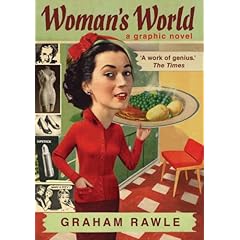
Further reading: Woman's World
To see more of Graham Rawle's creations and for sneak peaks inside Wizard of Oz, sally forth to http://www.grahamrawle.com/
Monday, 29 September 2008
Hope's Suffering - writing in lieu of a review of 'Linha de Passe'
The film sets it out neatly at first. Loneliness and belonging. On the side of the latter, the crowd at the Corinths football game, and the preacher's congregation. On the former, the boy riding the buses alone, the woman we saw at the game in her bedroom alone as her waters begin to break. The player in the try-outs, whose team-mates are his rivals.
It's not so simple. The church-goer has bought his place in the world at the price of the respect of his peers - nothing but scorn left for the 'bible-boy.' The boy on the buses has his family to go to - but he knows his real father is a bus driver and so he rides in the hope of catching a glimpse. And a motorcycle gregariousness sends him down a road that will end with complete alienation from his fellow human beings.
All of these characters are sited in one family - sons around a single mother in a São Paulo household too small to fit them. Their hopes play off one another and of course come into conflict, inevitably creating tensions in the plot - but they are not how the film moves. Fulfilment or otherwise depends on decisions made in each individual's sphere.
Most moving for me were the moments in which hope's embers faded. A lame legged woman is baptised in the river. The preacher lets her go and commands her to walk - but each time he has to catch her as she falls down into the water. Once he gives up the look of relief is palpable. It's the ending of hope's cruelty, the release of hope's suffering - that which happens when a hope is fulfilled, or put beyond reach.
It's not so simple. The church-goer has bought his place in the world at the price of the respect of his peers - nothing but scorn left for the 'bible-boy.' The boy on the buses has his family to go to - but he knows his real father is a bus driver and so he rides in the hope of catching a glimpse. And a motorcycle gregariousness sends him down a road that will end with complete alienation from his fellow human beings.
All of these characters are sited in one family - sons around a single mother in a São Paulo household too small to fit them. Their hopes play off one another and of course come into conflict, inevitably creating tensions in the plot - but they are not how the film moves. Fulfilment or otherwise depends on decisions made in each individual's sphere.
Most moving for me were the moments in which hope's embers faded. A lame legged woman is baptised in the river. The preacher lets her go and commands her to walk - but each time he has to catch her as she falls down into the water. Once he gives up the look of relief is palpable. It's the ending of hope's cruelty, the release of hope's suffering - that which happens when a hope is fulfilled, or put beyond reach.
Tuesday, 5 August 2008
Wall-E: a prose poetry review
For the past two weeks, I've been afraid a robot would break my heart. Ever since the trailers and the hopeful, inquisitive offering of a name. The correct spelling to recreate this, we have concluded, is “WaaaAAllee”.
Sure enough, despite fierce parries against tears at the absolutely lonely little roller's fate, I sat beeling like a stabbed water main by the end, grateful for the long credits and dim lights.
The things you can do with inferred eyes, bleeps and the clasping and unclasping of metal fingers.
Wall-E is already making number one in top movie robot lists. He is slapstick goof, tenacious underdog and affectionate, upbeat hero in one, and though his situation is almost painful in its desolation, Pixar never let Wall-E feel sorry for himself. No turn to the audience, no sad eyes and upturned palms, imploring them to join him in an “awwww” chorus. He just gets on with it, and once he finds his “Eeeevvaaa”, Wall-E risks everything without even running it past his processors first.
Many Short Circuit fans have complained that Wall-E is a straight skim of Johnny 5, compacted into loveable stumpiness, much as the bot himself crushes Himalayas of trash, before arranging them into towers as high as a doomed game of Tetris. While there is a likeness, this seems an odd critique. But then, most robots believe Ed Norton is a rip-off of the design mould used for Brad Pitt.
The humans, the humans. Odious and occasionally likeable. Some problems with the biology, and yes, better before we met them. Nice in-jokes and references to sci-fi leviathans like '2001: a Space Odyssey' – a nod to adults that it's OK to like this.
Disney does not do apocalypse. Disney had not done apocalypse till Wall-E. Being Disney, they had to sugar the pill with optimism, but honestly, I think I needed that, so as not to melt like Dorothy's witch, or fold to the floor in a ball. 'Wall-E' got me like 'Flowers For Algernon' got me, and yanked out a surprising scarf-string of emotions for such a short film. And while I respect cockroaches, I've never felt tender towards one before.
Friday, 27 June 2008
Review: 'Inextinguishable' by James W. Wood
 What is inextinguishable in James Wood's third chapbook? The Carl Nielsen quote on the inside cover, repeated in the final poem, suggests two things: music and life. The majority of Wood's poems, however, don't take their cue from that at all; instead what is inextinguishable is loss, pain, memory. Music and life are instead defiant forces, life in particular easily doused. This seems pointedly clear in Catherine Wheel:
"in that silence, only trees
and blackness and your mind
like a firework, wheeling crazily
in the middle of that sunless wood
where you stopped the car, full of pills ..."
While the immutability of suffering is succinctly reviewed in Self-Help:
"Her failure was not a path to the future,
her pain was not discovery. It was failure,
it was pain."
Raw stuff, and to the point. Inextinguishable has an I.M. dedication to Robert Anderson Wood, while another of its poems, The Craws, is in turn I.M. Alexander Wood. Though only two of the poems deal directly with death, it is foreshadowed in many of the others through bleak contemplation of lost opportunities and time passing, most pertinently in Afternoon Nap, in which the protagonist's ambiguous loss of consciousness is preceded by lines like "knowing that this day was done, or wasted" and "He should have written letters/but didn't". Time is played with here the same way it is in Simon Armitage's 2006 poem Evening, and again in After She Leaves where the 'after' could be anything from a few moments to decades.
As with his last collection, The Theory of Everything, Wood's lucidity is one of his greatest strengths. Contemporary poetry is flooded with collections that intellectualise death, seeking new profundity in its wilderness. Wood doesn't pursue the same holy grail; his responses are often surprising in their ordinariness and bitter honesty. Take this from The Craws:
"... You were
no prize-winner, sportsman or great thinker,
just a man like any other; and one
whose life asks us for little grieving."
Try reading that out at a funeral.
Wood's poems have here been paired up with the work of fourteen young artists from Edinburgh College of Art's Illustration Department, part of Knucker Press' self-appointed mission to publish collaborations "where word and image are mutually enriching". The layout is very effective, with the exception of a page which appears to be at too low a resolution. Many of the illustrations, however, are disappointingly literal, depicting the very scene or character the poem describes. The ones that work best are Toby Cook's not-quite-realist interpretation of Down the Drain and Genevieve Ryan's collage-esque The Craws, which swallows the poem in its sky, while it seems an odd choice to relegate Anna Kriger and Marc Noble's pieces to the contents page and back cover respectively when these do the best job of matching Wood's bristlingly dark tone.
Buy Inextinguishable from Knucker Press
Monday, 16 June 2008
A review of The Mighty Boosh 3 in the style (albeit very, very roughly) of a Luke Kennard poem

I
I loved The Mighty Boosh series 1. "It's set in a zoo," I used to tell people, as if that was all the information they needed to make an astute, well-informed judgement. Sometimes I would add: "The main characters are zookeepers."
The Mighty Boosh 3 is not set in a zoo but in a second hand shop. It does, however, feature Bob Fossil, the disturbed head zookeeper who does not know the names of any of the animals, and Bollo the gorilla, who no longer acts like a gorilla to any significant extent. To be frank, I would say that the series is all the poorer for not being set in a zoo, principally because the zoo setting was conducive to animal-based characters and counter-conducive to Shoreditch-based characters, of which there are far too many in The Mighty Boosh 3.
In fact, I wonder if The Mighty Boosh 3 is actually set in a Universe where everyone is from Shoreditch. "That's an idiotic notion," you might say. "A far simpler and more obvious explanation would be that it is merely set in Shoreditch." All well and good, but I would have thought that on an average day in Shoreditch you would probably have a far greater number of people who weren't from Shoreditch wandering around, perhaps looking for the way out or writing poems about Brick Lane.
II.
I have several criticisms to make, most of which I formulated in the midst of watching the series on DVD, immediately voicing them out loud to my companion.
"They are rolling out the same characters from the last two series," I said, "but not giving them anything new to do. See: Noel Fielding's Hitcher lingers threateningly, does the shuddering Cockney accent and copiously relieves himself. The Moon turns up twice every episode for a short, surreal monologue. The disembodied Tony Harrison creeps slowly but surely towards his 'This is an outrage' catchphrase."
III.
The second criticism I made, some time later, was this:
"The relationship between Vince and Howard has gone wrong."
"What do you mean?" my companion asked, obligingly.
Vince and Howard are the main characters in The Mighty Boosh. Vince is a vain and pretentious simpleton who is extremely fashion-conscious. Howard is an untrendy jazz enthusiast who sees himself as living 'outside the box', destined for greater things, but is all too often revealed to be shallow and foolish.
I explain that in the first series their relationship was finely balanced. Howard tended to be more frustrated, while Vince tended to exude a more positive attitude. While Vince was more popular and a great deal jammier, Howard was usually the 'leader', the instigator of their various quests and undoubtedly the more intelligent. Vince was 'cool'; Howard was 'hip'. They were both losers because they were both working in a zoo, failing to live up to the image each had of himself. The zoo was what kept them together; outside of the zoo, they had no mutual interests. They hated each other's music.
By the time we get to The Mighty Boosh 3, however, that balance has been distorted. Vince and Howard have now been friends since childhood. They are in a band together, despite their incompatible musical tastes. Vince is no longer a loser but a style icon, loved by everyone. Howard has become the butt of almost every humiliating joke in the series, and his only friend apart from Vince is a blind jazz man. When he makes a nervous speech at his own birthday party, a crowd made up entirely of spider-jeaned Shoreditchers stand and gawp at him, aghast at his uncoolness.
For some reason, none of this clueless mob are mown down with advanced weaponry. Instead, Howard's blind jazz friend has his head lopped off by an angry shaman.
"I hate everyone in this except Howard," my companion said.
IV.
Naboo and Bollo are the most featured characters in the series after Howard and Vince. They are fairly pointless. All they do is take drugs and humiliate Howard. This is a shame, because Naboo was one of the best elements of the first series, where he would turn up only occasionally to bestow wisdom and temporary powers upon the hapless protagonists.
The principle joke where Naboo is concerned is that he is supposed to be a mystic shaman but talks like an eleven year old with a slight lisp trying to play the archangel Gabriel in a school nativity play. Unfortunately, this joke no longer functions when Naboo is given too many lines.
You become numb to it.
Well, I certainly did.
V.
The Mighty Boosh 3 is a comedy series. By the time the DVD had finished, however, I had only laughed twice. Once was when Noel Fielding's golden shaman drug dealer briefly discusses spaghetti hoops. I cannot for the life of me remember the second occasion.
In the extras on the series 1 DVD, there is footage of a signing session with the stars of The Mighty Boosh. One fan is shown in a very excitable mood. He moves like he's accidentally stepped in a puddle of electrified water.
"By God, it is the best, funniest series ever, ever, ever," he tells Noel Fielding, who plays Vince.
Noel Fielding looks slightly scared, but must have since come to the fan's point of view. The Mighty Boosh 3 is surely a series for people who think the Boosh can do no wrong. Or else it has somehow become taken over - possessed, if you will - by the editor of the NME and other depressingly trendy types, perhaps wielding Fielding as their human puppet. What other explanation is there for Vince's newfound social invulnerability and the gratuitous cameo appearance of pastier-than-thou indie band The Horrors?
What other explanation is there for anything?
Tuesday, 27 May 2008
A review of 'Indiana Jones and the Kingdom of the Crystal Skull' in the form of a haibun
 Before I start the review, let me just say that I consider the new film to be the 6th, not the 4th proper Indiana Jones outing, since the Lucasarts adventure games Indiana Jones and the Fate of Atlantis and Indiana Jones and the Infernal Machine are both worthy additions to the canon. The first of these was a point and click adventure game which used the same engine as Monkey Islands 1 & 2 (and which was first developed for Maniac Mansion). Indy teams up with feisty flame-haired psychic Sophia Hapgood and must stop the Nazis discovering the secret of Orichalcum, the legendary metal of Atlantis, rumoured to be more powerful than uranium. As well as being a top-notch example of the all-but-extinct point and click genre, it's a classic Indy story, replete with archaeological arcana, fist fights and witty dialogue. The engine used to create it is now freeware, and as a result there are at least two 'sequels' in production, being made by fans. You can download the demo for one of them, Indiana Jones and the Fountain of Youth. It's pretty good!
Infernal Machine appeared a number of years later and is firmly based on the Tomb Raider series. While there's a lot more running around and jumping (as well as a clunky combat system) and a few overly fantastical enemies, there's still a decent cold war story, involving the ruins of Babylon and King Solomon's mines, plus some sharp exchanges between Indy and Sophia (who returns with a new haircut).
Doug Lee voices Indy in both these games and is every bit as dry as Harrison Ford. After playing through them, you'll find yourself imitating some of his choicest expressions. It's been a while since I've played either, but two come to mind: his frustrated "Sophia!" and, hilariously, "Well, well. An entrenching tool," (upon discovery of a spade).
There are other stories in the Jones franchise as well, but having watched a couple of episodes of The Young Indiana Jones Chronicles, I prefer to discount them. Spielberg would have us believe that during World War I Indy was simultaneously present at the trenches, taking on the Luftwaffe in the air and playing a vital role in the Allied spy network. Chew on that, Biggles.
I don't really think much of Lucasarts' third Indy game, Indiana Jones and the Emperor's Tomb either, since it was even more action-orientated than its predecessor, with only a loose plot, hardly any dialogue (or comedy) and no Doug Lee. Really, it was only a game, whereas the first two were also stories. As for the comics and novels (??) I've never encountered any of them face to face.
Now for my review in the form of a haibun. Haibun, if you're wondering, are a mixture of haiku and prose poetry. Further information can be gleaned from contemporary haibun online, a quarterly journal.
The Review
The major failing of this film is symbolised by the protagonist's trousers. Something about them is deeply wrong but you can't quite remember what trousers Indy was wearing before, so it's hard to put a finger on the problem. Is the waistband too high? Is it that they seem rather too neatly pressed? Are they too beige? Too lightweight? Should they, by rights, be as ravaged as his shirt after he's survived crashing through several panes of glass, a jet engine ride, cascades of pinging bullets and an atomic bomb?
There are, of course, flaws that you can identify. Plausibility is stretched beyond breaking point. A man's nose is broken, only to be completely healed within moments. Indy stands at the very cusp of a whirling tornado of debris and doesn't even get dust in his eyes, let alone lacerated to a bony stump. Indy and Marion have a heated (and very loud) exchange just beyond the borders of the enemy camp they've escaped, yet the soldiers pursuing them through the jungle still can't seem to track them down. Characteristic Lucasfilm CGI (ie. still less convincing than a Harryhausen creation).
But all would be forgivable in the context of a film that really captured the feeling of the first three flicks. Between a rickety script, cranky actors and creaking sets, Indy 4 never quite gets there.
Indiana Jones
and the Saucer Men From Mars?
Not quite but nearly.
Monday, 26 May 2008
Guest Review: Andrea Tallarita on Jane Weir's 'Before Playing Romeo'
 Before Playing Romeo by Jane Weir, Templar Poetry, £9.99
Click here to buy
Tensions of language and communication are at the heart of Before Playing Romeo, the second poetry collection by Jane Weir. “I know not how to tell you who I am,” a line from Romeo and Juliet, is the epigraph for the poem which gives the volume its title, and this concern recurs everywhere in the volume: “you do not know me, / nor I you and never will,” she declares dryly in Window. This title is in turn revealing: the ‘window’ is another recurrent trope in BPR, a symbolic point of passage through which we see in and are seen into. The image is wilfully ambiguous, and the rest of her collection follows suit. Most of the poems which Weir addresses to an acquaintance or an interlocutor subtly double up as messages from the poet to the reader. One is constantly on the edge between spectator and addressee: like Romeo himself, the meaning of these poems is constantly in play. Language is correspondingly elusive and unpredictable (though in its usage Weir has some clear debts towards other past poets; Marianne Moore, Sylvia Plath, Elizabeth Bishop): internal rhymes are scattered across poems that would otherwise seem unstructured, and when a scene finally seems to be depicting an instance of communication, it is more often through the characters’ mutual silence than through their mutual speech.
It is on this linguistic plane of playfulness and sudden epiphanies, of skidding and dipping through surfaces of meaning, that the collection takes us on its thematic voyage through places and memories. Milan, Venice, Carrickfergus; from Ireland to Italy, BPR sweeps over a wealth of Mediterranean experiences. These experiences are charged, intense with recollection and atmosphere. Weir is at her best when she can bring together the ambiguity of her language with the concreteness and stability of her memories: the ‘Ralph’ poems, dedicated to her husband, are an example of that (“Even in this tender heat / the flies persist / as though I’m / a house party / and my eyes / the ballroom floor / of their mansion, / where they deposit gifts / around my irises / as if they are card tables” – Ralph in Florence).
The recollection of experience can be at once familiar and alienating, in accordance with the ‘play’ of the text: some images tend to unsettle as much as they please, such as the sky which ‘belched red gold’ of In Our Dinner Hour, Wigan or the ‘monstrous’ sun of First Night with the Cave Hill Behind. The process is of course very self-aware; several of Weir’s poems are about the process or act of creating the text (Via Gellia; Exile, Artists Corner; At Helens’ Bay…). Yet it is precisely that which goes beyond the text, or which exists behind it, which in these poems is the realm of communication – the other side of the window. Since direct, binary communication through the Word is not possible, the most that these poems aim for (and, by extension, the most that we can attain in our experience) is not a steady stream of exchange, but a fleeting moment of contact, the ‘tremor before flight,’ as she beautifully puts it in Before Playing Romeo, in which we are not so much constantly talking or hearing but ‘nearly touching’ (The Cave of the Golden Calf).
The cover of Before Playing Romeo consists of a painting of Bacchus by Caravaggio. This, along with the reference to Romeo and some of the poem titles (The Cave of the Golden Calf, Copper Vase, Harpies and Phineus), suggests an interest in the flourishing historical periods of the Mediterranean lands she visits in her poems – the classical ages and the Renaissance. This expectation, however, is not fulfilled; her poems never go beyond a cursory, casual reference to Apollo or to Zeus. This is a shame, because Homage, a poem dedicated to Charlotte Mew and Christina Rossetti, sees Weir engaging very successfully with the modern mythologies surrounding these two poets, and suggests she would have the competence to deal with more ancient ones as well. Some of her poems might benefit from being steeped not only in the rich atmospheres and climates of the lands they visit, but also in the equally rich cultures which matured in them, and which, in BPR, are remarkable only for their absence.
But then, perhaps these themes go beyond the interests of a collection as intimate as that of Weir; and as her choice of epigraphs suggests (Oscar Wilde, Colette, James Baldwin), Jane Weir is a modernist through and through. In a postmodern age which often forgets the value of concrete, sensual experience (or at least refuses to express it), it is refreshing to read poems which take us back to lanes with soft earth under our feet, to tender sunlight and the wind that ‘froths the sea.’ They might not always be as historically erudite as one may wish, but they are textually subtle, often inspiring, and pleasingly mature. I mean it as a true compliment when I say that they are a good old wine in new bottles – a Piedmontese Barolo, to be precise, produced in Cuneo, by the Borgogno family, and seasoned six years.
Andrea Tallarita
Subscribe to:
Posts (Atom)


